Rapid Prototype Trends
November 6, 2010 by Steve Meyer
Filed under Commentary, Design, Industry, Manufacturing Trends, Materials, Simulation, Technology
3D solid model software has come a long way. It makes complex finite element analysis an integrated feature so that new designs can be explored in hours, rather than days or weeks of building prototype parts and making changes. New product development costs have been falling consistently since the advent of this technology.
The logical extension of 3D solid modeling software is 3D rapid prototyping. This technology has also gone through significant changes over the last twenty years to reduce the cost and make it available to a wide audience. Development of file format conventions have made the link between 3D solid modeling and 3D printing very straightforward.
In its early days, 3D printing started out as stereolithography. This term was coined for the two laser beams that were used to cure liquid polymer in a large tank. Precision steering and focusing of laser beams has been around for a while from the laser printer world. Adapting the laser printer technology resulted in tremendous precision with part accuracy of .001″ in any dimension being easily achieved. This made evaluating complex fit and function very easy for manufacturers. At its inception, stereolithograyphy machines were $250,000. The high price tag made stereolithography the domain of Fortune 500 companies. But for high volume, complex parts like intake manifolds for automotive engines, stereolithography was, and still is, a great way to save money when a new part design is required.
Heat curing a liquid polymer gave way to heating a low melt point polymer to a liquid and dispensing it in small beads as a lower cost solution for making complex shapes. To the point where there are a wide variety of solid model printers in a desktop package that are priced under $20,000 with really sophisticated features like multicolor part generation, and new low end machines coming in from China at $1500.
Experimentation with different chemistries has created a wide range of options with regard to material strength and imparting unique properties to the parts. One variation is ABS plastic that is available with glass fill. This produces much higher strength parts than the polymers. Another whole branch of 3D printing is dedicated to making metal parts that are too complex or expensive for conventional machining. Amazingly, the 3D-based solutions are resulting in much lower costs.
The implications are transformational for new product development. First, the combination of 3D solid model software and 3D printing technology taken together represent an order of magnitude reduction in the cost of developing new products. The technology make more information available leading to, hopefully, better design. This also means that the amortization cost of the development activity is also greatly reduced. Leading to better goods at lower prices.
The second transformation is that lower development costs mean that the technology can be applied to lower price products. Previously, these technologies were only cost effective in automotive and medical instrument design applications. Now, the potential exists to dramatically improve products at lower price and volume levels. Sneakers, for example, have been impacted by this technology leading to a wide range of new products incorporating a variety of new ideas.
And the transformation is just beginning. And all of it mechatronics driven.
Siemens PLM Mechatronics Software Derived From Video Games
September 21, 2010 by admin
Filed under Simulation, Technology
Siemens PLM Software announced a new integrated machine design solution aimed at creating value for companies that develop and market machine tools and production machines. Mechatronics Concept Designer™ represents a paradigm shift for the industry with a new systems engineering approach to machine design that captures “voice of the user ” input, manages early requirements and facilitates the simultaneous definition and simulation of the complex mechanical, electrical and automation software found in today’s increasingly complex machine tools. With an easy-to-use, interactive simulation capability based on groundbreaking “gaming” technology, Mechatronics Concept Designer can help significantly reduce development time and improve product quality for the global machine design industry.
Siemens PLM Software’s Mechatronics Concept Designer solution enables entire development teams to collaborate more effectively from the beginning to the end of the machine design process, thereby allowing them to catch and easily correct issues early, before they become costly manufacturing or customer related problems.
An Integrated End-to-End Systems Engineering Approach
The development process in the machine tool industry requires experts from several different disciplines, including mechanical, electrical, and software design, to develop a complex machine to the specific requirements of each individual customer. Traditional software tools don’t take requirements into account, and the lack of a “common language” has made it difficult for these disciplines to integrate with each other until the end of the design process when changes are more costly, both in time and money. This fragmented set of design applications combined with the complexity of the machines, has made it virtually impossible to simulate and evaluate various design concepts to support rapid and effective product development decision making.
Siemens PLM Software’s Mechatronics Concept Designer enables mechanical, electrical, and software/automation disciplines to work in parallel. It includes all the powerful mechanical design features of NX while enabling the user to develop a list of sensors and actuators which can be easily selected and positioned, laying the foundation for the electrical engineers to create the layout plan. And more efficient software development is supported through the ability to make the machine’s sequence of operations available in a standard format common in the machinery industry.
Working in conjunction with Teamcenter, the world’s most widely used PLM system, Mechatronics Concept Designer delivers an end-to-end machine design solution with an integrated systems engineering approach. At the beginning of the development cycle, designers can use the Teamcenter requirements management and systems engineering capabilities to build a functional model that ensures customer requirements are incorporated into the design.
Video Game Technology Enables Groundbreaking Simulation
Mechatronics Concept Designer also includes a state-of-the-art modeling and simulation capability based on NVIDIA® PhysX® technology. This physics engine, developed with the PhysX SDK from NVIDIA, is similar to the software technology used in many of today’s modern video games. This groundbreaking approach to simulation makes it easy to quickly create and interactively validate alternative design concepts. In addition, the user is able to interact with the digital machine model while the simulation is running, providing the ability to test the effects of different inputs in real time. The ability to model real-world physical behavior in the virtual world, based on simplified mathematical models, enables early concept verification that helps detect and correct errors when they are least expensive to resolve.
Siemens PLM Software at IMTS
Mechatronics Concept Designer is being demonstrated in booth number E-4040 at IMTS. Attendees at IMTS also have the opportunity to observe several other technology solutions from Siemens designed to maximize manufacturing productivity including the Tecnomatix Virtual Machine solution mentioned above.
Universal Robotics Lauches 3D Software Compatible With Webcams
August 12, 2010 by admin
Filed under Design, Industry, Manufacturing Trends
Universal Robotics, Inc., a software engineering company, announced the launch of two simple-to-use 3D vision software products: Spatial Vision and Spatial Vision Robotics. The products can turn any pair of webcams into a highly accurate, cost-efficient 3D vision system that can be employed in virtually any setting without expensive equipment.
With Spatial Vision and Spatial Vision Robotics, a user can plug in the cameras, calibrate their space and receive highly accurate measurements in under 30 minutes. These products will expand the use of 3D vision to markets where it hasn’t been feasible before.
3D vision systems offer many benefits over their 2D counterparts, including better accuracy and object identification and tracking, which are essential features in security, engineering and robotics applications from biometrics to real-time control of machines. Despite their benefits, broad adoption of 3D vision systems has been limited in many markets because the systems can be costly to implement and maintain.
Universal’s Spatial Vision products eliminate the need for the precision mounting, specialized cameras, and time-consuming set up that is required for many 3D vision systems. Using two webcams that can be set up and calibrated within a matter of minutes, Spatial Vision and Spatial Vision Robotics can determine the 3D position of any point relative to the cameras with millimeter accuracy.
The Spatial Vision product can be easily deployed in any setting in which cameras can be installed, including laboratories, office buildings, department stores and warehouses, and is an affordable solution for anyone looking for an accurate way to observe and measure an environment. It can be employed in security applications, measuring in-store foot traffic patterns, and more scientific applications requiring object tracking and visual analytics without a wand or sensing device. Spatial Vision offers 30 percent improved accuracy over 2D systems used in object identification and tracking applications, such as facial recognition and other biometrics. It is optimized for use with popular Logitech 9000 webcams, but can be customized to work with any USB 2.0 camera.
Spatial Vision Robotics has been specially designed to be used in concert with automated machines. By adding LEDs to points of interest on moving machinery, Spatial Vision Robotics provides 3D position on the machine and its surroundings in robot coordinates as seen from the camera. The program enables 3D calibration between the extrinsic object of interest, the robot and the cameras, as well as intrinsic calibration with the cameras. It can work with any robot and is currently optimized for Yaskawa America (Motoman) SDA-series robots. Spatial Vision Robotics can be integrated with path planning and high-speed inverse kinematics to enable real-time control of robots.
Spatial Vision and Spatial Vision Robotics were created as part of the development of Universal’s signature technology, Neocortex™, a sensory-motor based form of artificial intelligence that enables moving machines to learn from their experiences and perform tasks that are unsafe or difficult for humans. Neocortex was developed over seven years with NASA and Vanderbilt University, and was funded by U.S. Department of Defense.
Sartorius Introduces ProBatch+ Software
November 20, 2008 by admin
Filed under Automation, Networks
Goettingen, Germany – The Sartorius ProBatch+ software used in conjunction with the Sartorius X-Family, Combics Pro, and other PLC controllers offers the user efficient management of original raw material and recipe data. The powerful ProBatch+ software program allows for visual presentation of the running process and enables all batch procedures to be both visually monitored and easily controlled.
Read more
Motion and Easy-to-Use
October 12, 2008 by Steve Meyer
Filed under Motion Control
I get a little crabby about some of the things I have seen over the years in the motion control and especially the American marketing mentality. In particular, the words “motion control” and “easy to use” should not appear in the same sentence without great care and thought about the statements being made. If there is any lesson in the last two blogs on simulations and analytical tools for system design, it is that the motion control field is complex.
It is certain that computers and ever more powerful software programs automate tasks so that we can work more quickly. The tools are evolving to make design faster and more thorough. Many programs embed software oscilloscopes to display important parameters of operation while we tune or test our work. And I love anything that makes my job easier, as I’m sure you do. Read more
Danaher Motion Introduces MechaWare 3.0
July 16, 2008 by admin
Filed under Motion Control
SANTA BARBARA, CALIF — Danaher Motion introduces MechaWare 3.0 — the industry’s only mechatronic toolkit that seamlessly integrates mechanical systems and control software design resulting in faster design cycles, superior motion system performance, and faster time to market.
Better Software Tools
February 5, 2008 by admin
Filed under Automation, Motion Control, Simulation
Better Software Tools Help Machine Builders Reap the Benefits of Mechatronics.
Newer software programs intended for machine builders take advantage of mechatronic principles and easily blend the necessary and different engineering disciplines.
By John Pritchard, Global Product Marketing Manager
Kinetix Motion Control, Rockwell Automation
Traditionally, machines have been designed and built using individual mechanical, control, and electrical design teams — that work independently to produce separate pieces of the whole system. Often, the mechanical team will turn the design over to the controls team and hope they can integrate the software and controls before control and programming issues are addressed. The machine might deliver substantial performance and flexibility advantages, but typically the marriage of the mechanical functions with the control system is not optimal; it is merely sufficient. Read more
The Evolution of Motion Programming Devices
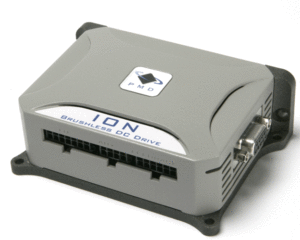
February 5, 2008 by admin
Filed under Motion Control
Here’s a closer look at software development for programming motion systems and how these choices affect software reusability.
By Chuck Lewin Performance Motion Devices
Software development can be the single greatest engineering cost for many machine design projects. This observation is especially true for motion control projects because of the inherent complexity of managing such real time tasks as profile generation, events, and throughput.
Do you protocol?
It’s easy to be a bit overwhelmed with the range of choices in motion control protocols, languages, interface standards, and control architectures. However, as it turns out, a few basic concepts provide the necessary foundation for understanding motion programming languages. Read more