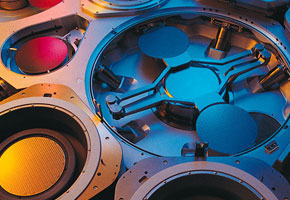
Chips, Chips, Chips

Semiconductor manufacturing is still a little bit like magic.  It’s hard to imagine packing millions of transistor into tiny spaces and creating  cellphones, computers, flat screen television, digital cameras, CD players and so forth.  And the industry keeps pumping out the innovations.

And there are so many technologies, all focused on solving application problems but balancing the economics of development cost and manufacturing scalability.  Where would the Oui or iPhone be without accelerometers that are really inexpensive?  Fax machines without G3 communications chips,  or $49 printers without stepping motor chips and ink jet controls?  All benefits of high volume economy of scale.

Industrial control systems have generally required chip technology, but in numbers of chips considered too small to merit custom designed solutions.  But the Rockwell Control Logix concept breaks the partitioning of applications by applying the same control processor to all kinds of control equipment, variable frequency drives, programmable controllers, HMI’s, you name it.

Is there an ultimate chip?  A chip solution that does everything?  Not really.  But the wizards of the microcircuitry world keep coming up with new architectures.  New approaches to existing applications that offer price or performance attributes that will hopefully trigger lots of new designs that result in breakthrough products.

Recent trade press is buzzing about a new processor that combines the logic solving capability of FPGA (Field Programmable Gate Arrays) with ARM (Advanced Risc Machines).

FPGA excels in the ability solve logic, and has scaled up to massive numbers of gates and tremendous processor speeds to solve enormously complex applications.  Even applications requiring real time operation like motor control can be solved through FPGA with proper attention to detail.   Applications that were considered impossible a few years ago are now within the range of these processors.

But using gate arrays may not be the most efficient way to do motor control.  Hard real time motor control requires a great deal of analog processing to monitor conditions in the real world (like voltage and current) and the ability to respond to dynamic changes through complex programming and mathematical models.  Much easier for ARM processors with super efficient instruction sets and single cycle multiplication and division.  In some designs 16 channels of high resolution A to D converters and direct PWM capabilities.

So combining the two technologies seems like the ideal solution for a huge range of industrial control applications.  And if you get it all in one processor, wouldn’t that be great?

I  can’t wait to see what new product developments take place in the next few years with this kind of processing power available.

Mechatronic Top Ten – Hard Disk Drives

May 31, 2009 by Steve Meyer  
Filed under Automation

One of the mechatronic Top Ten applications has to be the hard disk drive.  Strangely, it is not an application that you hear much about.  That’s probably because unless you work on hard disk drive design, you pretty much take for granted that little black box that stores all your information. So the group that is actually pushing the design frontier of hard disk drive technology is a very finite group.  There are only a dozen companies actually making disk drives these days, after consolidation in the market has resulted from acquisitions and mergers over the last decade.

Worldwide consumption of hard disk drives is in the tens of millions per year, and like all things electronic and high volume, the industry produces ever more memory at ever lower prices.  The absolute value of hard disk technology is one of the most incredible bargains in the world.  The current state of the art is about 10 cents per gigabyte which is quite a bargain compared to the 1.5 Megabytes for the old 3.5″ mini floppy disk.  With seek times in the low milliseconds, memory is almost instantly available due to 7200 RPM platter speeds.  The 7200 RPM speed is the equivalent of 75 miles per hour at the edge of the platter.  Higher speeds have been delivered, but the thin aluminum platter is subject to “flutter” which can cause a head crash.

The spindle motor is a 3 phase dc brushless motor that is designed to accelerate the memory platter to the 7200 RPM running speed in just 2 or 3 milliseconds.  This is an incredible feat considering that the power available is limited to a small lithium battery.  Further, the spindle motor must coordinate it’s motion with a linear actuator to place the drive’s read head a few millionths of an inch above the platter surface at the exact target sector on the disk.  So, just getting the platter to spin, which is hard enough given the time constraints, is further complicated by the extreme challenge of coordinating the rotational motion with the linear motion of the read head.

What makes this all even more astounding is that the budget for the motor can only be a few dollars, given a retail selling price of $60 for the whole package including the memory.  I don’t know how these guys come up with the solutions, but they consistently do and they consistently do it at lower prices.  The last thing I remember reading about was the elimination of bearings in favor of fluidized bearings.  At 60 million units, saving money on bearings adds up to a lot of money.

One of the many ironies of the hard disk drive is that it is at the root of many improvements in industrial motion control.  The venerable 33035 controller chip from Motorola was developed specifically to run hard disk drives.  It later appeared in a number of industrial servo amplifier designs delivering precise control of higher current power to a variety of brushless dc servo motors.

You never know where the breakthroughs are going to come from, but we keep them coming.  Keep up the good work!

Silicon and the Economy

June 22, 2008 by Steve Meyer  
Filed under Semicon

The semiconductor industry is the largest economic segment of the US economy. We still dominate in a few areas. Semiconductor equipment, hard disk drives, computers as finished products, laser printers and inkjets are some of the product areas where American companies continue to dominate. And a lot of the innovation that drives technology originates in the US. Read more

Silicon, the Final Frontier (2)

June 19, 2008 by Steve Meyer  
Filed under Motion Control, Semicon

When you consider the technical issues of making semiconductors, it seems impossibly difficult. Semiconductor fabrication requires lithographic processes to create features that are measured fractions of an Angstrom, the unit of measure of wavelengths of light. Pretty small. The least contamination or vibration that isn’t supposed to be there can ruin parts.

Wafer polishing machines must polish the slices of silicon to a flatness and perfection that can’t be measured by conventional means. Multi-axis robots handle silicon wafers in vacuum chambers without putting the tiniest scratch on the surface. Wafer cassettes with $250 to $500K worth of uncut chips have to be shuttled from process machine to process machine inspected and tested for defects. Read more

Silicon, the Final Frontier

June 19, 2008 by Steve Meyer  
Filed under Semicon

It used to be said that what’s good for Detroit is good for America.  This idiom referred to the dominant role of the automotive manufacturing in the American economy.  During the boom of the 1950’s and 60’s many controls companies grew into their current positions as dominant controls suppliers by developing ever more powerful solutions for automating the auto makers.

It is somewhat ironic that as we move into the e-tainment era of the 2010’s, surrounded by e-media delivered by ever more powerful portable electronics, that the US semiconductor industry is at least the size of, and by some accounts, a much larger enterprise than the auto industry.   The Department of Commerce shows semiconductor manufacturing at $90B for 2002 and computer manufacturing at about $88B, some of which of course is overlapping.  If you start adding all the flat screen display, cellphones, well, you get the picture.  Semiconductors enable so many products that we take for granted, it is hard to estimate the impact. Read more