Maxon Announces Strategic Collaboration with National Instruments
February 11, 2010 by admin
Filed under Automation, Robotics, Technology
Maxon Precision Motors is pleased to announce a strategic collaboration with National Instruments (Austin, TX). The initiative will look to highlight mutual areas of interest in the field of robotics. An informal relationship between the two companies was initiated as early as 2006, with the inclusion of NI LabVIEW VIs in Maxon’s EPOS family of digital position and speed controllers. Most recently the two companies collaborated on the design and development of ViNI , an all inclusive robotics platform created by engineers at National Instruments. ViNI is driven exclusively by Maxon motors, gearheads and encoders and NI CompactRIO embedded controls.

“NI and Maxon have worked together to integrate the high productivity of NI LabVIEW graphical software and the high-precision drive systems of Maxon Motors so roboticists don’t have to assume the integration workload,” said Shelley Gretlein, Senior Group Manager of LabVIEW Real-Time & Embedded at National Instruments. “Also, with the release of LabVIEW Robotics software, design engineers now can access native Maxon Motor interfaces ready-to-run on their next autonomous system.”
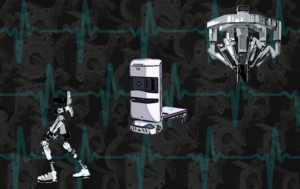
Other notable robotic applications driven by Maxon motion control products include the Mars “Rover” by Jet Propulsion Laboratory, “Da Vinci” surgical robot by Intuitive Surgical and “DARwin” the humanoid robot developed at RoMeLa, the Robotics & Mechanisms Laboratory at Virginia Tech University.
Both Maxon and National Instruments recognize that advancements in each respective area of expertise are complementary and look to provide designers with state-of-the-art hardware and software solutions for developing new robotic products and applications. Several joint marketing efforts are slated for 2010. Maxon will continue to focus its R&D efforts on electric motors, sensors and motion controllers while National Instruments will leverage its LabVIEW platform, NI LabVIEW NI SoftMotion Module, and CompactRIO.
“It is an exciting time to be involved in the robotics industry. Over the years Maxon has directed a significant portion of our engineering efforts toward the development of specialized products for robotic applications, and we are just beginning to realize the benefits of our investment. We are pleased to be working with NI and their talented group of engineers”, states Kirk Barker, Electronics Product Manager.
CompactRIO, LabVIEW, National Instruments, NI, ni.com and SoftMotion are trademarks of National Instruments. Other product and company names are trademarks or trade names of their respective companies.
National Instruments
www.ni.com
maxon motor
www.maxonmotorusa.com
Hope For the Future
October 13, 2009 by admin
Filed under Commentary, Robotics, Technology
By Richard Comerford, Editor, Electronic Products
One of the most frustrating things that we experience in our day-to-day existence is not being understood. As engineers, we’ve all run into people who have no idea what it is we actually do, and seem totally ignorant of the basic scientific principles and techniques we use every day. And those of us who have been around awhile may be tempted to tell those who are experiencing this frustration for the first time that it won’t be the last time they run into the situation.

But recently I was given hope that the aforementioned situation may really be changing – that in the future, what we do as engineers will be less foreign to the world in general. The occasion was NIWeek, an annual meeting in Austin, TX, sponsored by National Instruments.
For those of you who haven’t attended this event – and if you really want to keep up with what’s happening in mechatronics you really should go to this show – the program includes opening keynotes each day that are a significant departure from the usual. Instead of someone just talking to you about technology developments, keynote speakers provide live demos of what the technology they’re working on can do. (You can see these keynotes at National Instruments’ Web site, http://www.ni.com/niweek/.) One of the keynote speakers, Ray Almgren, NI Vice President of Academic Marketing, made the following observations: “Through our work with LEGO, we’ve learned that kids are born with an innate sense of creativity. They are innovators; they are engineers – from the time they are born.”
Acting on that realization, NI is actively going about encouraging the development of engineering abilities, not only at the university level, but in high schools and elementary education institutions. They are a major contributor to FIRST (www.usfirst.org), a not-for-profit organization, founded by Dean Kamen, that aims to inspire young people to be leaders in science and technology; it does so by sponsoring robotics competitions that are like scientific Olympics, complete with team uniforms and a large stadium for competitions.
NI has also been working with LEGO to create toys that preschoolers and kindergarten kinds can use to build and program simple robotic systems. And they are backing a competition called Moonbots (www.moonbots.org) in which small teams composed of children and adults compete to design, program, and construct robots that perform simulated lunar missions similar to those required to win the $30 million Google Lunar X PRIZE, a private race to the Moon to encourage commercial exploration of space.
The dedication of all those involved with these projects gave me hope that perhaps that feeling of being misunderstood just might disappear in future generations. “We are creating a new generation of engineers and scientists,” said Almgren, and that generation may not only make me feel more comfortable, they just may solve a lot of the world’s problems. As Almgern noted, “they are the real stimulus package.”
Robots created by high schoolers compete in a FIRST event.
Stäubli Robotics Announces Next Generation Robot Series
June 18, 2009 by admin
Filed under Featured Mechatronic Articles, Robotics, Technology
Stäubli Robotics announces the introduction of the new TS series of high speed SCARA robots. This next generation robotic line features 100% Stäubli design and engineering, and are among the fastest commercially available SCARA robots in the industry. Stäubli’s high performance benchmarks of speed, rigidity and precision are exemplified by this series which includes the TS40, TS60 and TS80 with a range of 400mm, 600mm, and 800mm reach and a payload of up to 8kg. This represents a 30% increase in performance and higher inertia capabilities over the previous RS series of robots.

All TS series robots feature four-degrees of freedom, a hardened plastic external housing and electric servo-driven motors for reliability. These robots utilize the CS8C controller which features a compact lightweight design and is the most technologically advanced controller ideally suited for applications that require complex process control. The CS8C utilizes the VAL3 programming language which is perfectly adapted to robotics and features numerous possibilities to communicate with the outside world including several different Fieldbus options, Ethernet, ModBus, and an offline programming software package (SRS) for ease of integration and use.
The TS series is highly adaptable and well suited for a wide variety of high speed and precise applications including pick and place, material handling, packaging, assembly, loading, testing, and dispensing. These new robots increase productivity and throughput without giving up valuable floor space making them ideal for food, pharmaceutical / medical device, PV, automotive, electronics, and many other industrial market segments.
“The new high speed TS series robots are the next generation of SCARA robots reinforcing Stäubli Robotics as the leaders in innovation. This new SCARA series is best in class in regards to speed, reliability, and precision – offered at a competitive price.” says David Arceneaux, Operations Manager-Assistant Division Manager at Stäubli Robotics”.
Today, Stäubli offers the widest range of 4 and 6 axis robots from 0.5kg to 250kg payload and from 220mm to 3500mm reach, all controlled from a common control platform.
Rixan Introduces Fully Ease-Of-Use Swivel Stand System
March 26, 2009 by admin
Filed under Robotics, Technology
Dayton, OH — Rixan Associates, Inc. recently introduced unique Swivel Stand Systems (the RSS-1000 and RSS-2000) that offer repeatable positioning for automated operations.

In many automated machining operations, the operators require access to the machine to set-up the job and perform routine maintenance. The robot, or automated feeder, must be removed and later reinstalled to provide the access.
The Rixan swivel stand allows the robot to swivel out of the way for access, and later, be easily repositioned with excellent repeatability.
According to Stephen Harris, President of Rixan Associates, the Rixan Swivel Stand is very rigid with repeatable support of a robot or other machinery up to 250 kg (550 lbs). The mounting pattern can be set to client specifications with various heights and arm lengths available.
New Software Enhances Robot Simulation
There is now a more accurate way to simulate robots in action before they’re put to work, thanks to new software developed by Microsoft and DS SolidWorks. The new simulation capability helps companies program robots more quickly and effectively.

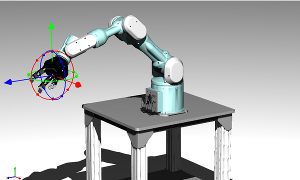
With Microsoft RDS, you can incorporate 3D CAD models designed in SolidWorks software and simulate robot operation more accurately.
Users of Microsoft Robotics Developer Studio 2008 (Microsoft RDS) will be able to directly incorporate 3D CAD models designed in SolidWorks software into Microsoft’s Visual Simulation Environment (Microsoft VSE) and accurately simulate their operation. Robotics developers can correct any robotic application issues early. The solution takes advantage of the fact that both applications support a common XML format, COLLADA, for rendering 3D objects and motion. A demo of the system is available now at SolidWorks Labs, and for download.
You can download the free SolidWorks/Microsoft RDS integration software, export a SolidWorks robot design into Microsoft VSE, develop the robotic application, then simulate the robots’ operation prior to deployment. The integration preserves dimensions, constraints, mass properties, motors, springs, colors, textures, and more from the SolidWorks model. Download from http://labs.solidworks.com/
“The worlds of machine design, mechatronics, and robotics are converging, and this first-of-its-kind partnership is just one way we’re supporting the convergence,” said Fielder Hiss, director of product management at DS SolidWorks.
Microsoft Corp.
www.microsoft.com
FIRST Launches Eighteenth Robotics Competition
Manchester, NH – FIRST (For Inspiration and Recognition of Science and Technology) launched its eighteenth FIRST Robotics Competition season today with a Kickoff of a new robotics game called “Lunacy” at Southern New Hampshire University in Manchester, NH, hometown and headquarters of FIRST.
“Forty years ago, NASA fueled a generation’s imagination with the success of Apollo 11. As we celebrate that remarkable feat of technology and engineering with our 2009 game, “Lunacy,” we are sparking more of that kind of inspiration through the FIRST Robotics Competition,” said FIRST founder, Dean Kamen. “Just as NASA scientists landed a man on the moon and returned him safely to earth in 1969, so too will these young people go on to explore new frontiers and develop breakthrough technologies that will change the world.”
The FIRST Robotics Competition is an annual competition that helps students discover the rewards and excitement of science, engineering, and technology. More than 42,000 high-school students on 1,686 teams from the U.S., Brazil, Canada, Chile, Germany, Israel, Mexico, the Netherlands, the Philippines, Turkey, and the U.K. are participating in this year’s competition.
“In today’s social environment, FIRST has a chance to re-define the larger economic and moral playing field,” noted Dr. Woodie Flowers, FIRST national advisor and Pappalardo professor Emeritus of Mechanical Engineering, Massachusetts Institute of Technology. “Our students can be their own economic stimulus packages by leveraging their skills into self-sustaining careers and help with the issues we face in the 21st century.”
In the “Lunacy” game, robots are designed to pick up 9″ game balls and score them in trailers hitched to their opponents’ robots for points during a 2 minute and 15 second match. Additional points are awarded for scoring a special game ball, the Super Cell, in the opponents’ trailers during the last 20 seconds of the match. “Lunacy” is played on a low-friction floor, which means teams must contend with the laws of physics.
At today’s Kickoff, teams were shown the game field and received a Kit of Parts made up of motors, batteries, a control system, and a mix of automation components but no instructions. Working with mentors, students have six weeks to design, build, program, and test their robots to meet the season’s engineering challenge. Once these young inventors create a robot, their teams participate in competitions that measure the effectiveness of each robot, the power of
collaboration, and the determination of students.
Sponsored by NASA, PTC, Booz Allen Hamilton, and Worcester Polytechnic Institute, the exciting Kickoff event gave teams the opportunity to see the new game for the first time. Teams across the nation and in Canada, and Israel watched the proceedings via NASA TV broadcast or webcast from 52 local Kickoff sites, many of which also offered workshops and a chance to meet other teams. The agenda included presentations by FIRST founder Dean Kamen; PTC executive vice president and chief product officer James E. Hepplemann; NASA program executive Dave Lavery;
FIRST chairman John Abele; FIRST national advisor Dr. Woodie Flowers; and FIRST president Paul R. Gudonis. The program also featured the premiere of the 2009 FIRST Safety Video, presented by the Fabricators and Manufacturers Association and Underwriters Laboratories.
In 1992, the FIRST Robotics Competition began with 28 teams and a single 14 x 14 foot playing field in a New Hampshire high school gym. This season, 1,686 teams including 322 rookie teams will participate. Forty regional competitions in the U.S., Canada, and Israel, plus seven district competitions and one state championship in Michigan, will lead up to the 2009 FIRST Championship at the Georgia Dome in Atlanta, April 16-18. FIRST programs are operated by over 85,000 dedicated volunteers worldwide, many of them professional engineers and scientists who mentor the next generation of innovators.
Expert forum on the future of Service Robotics
The Lauffen, Germany based clamping and gripping specialist SCHUNK will be holding a new edition of the Service Robotics Expert Days on February 18th and 19th, 2009. The international expert forum will be attended by leading authorities in the field, bringing together experts from all around the world. A wide range of presentations in English will give participants an overview of the current situation and future possibilities for the Service Robotics industry.
Read more
KUKA Robotics Introduces New Food Series Robots
The new KUKA Food Series Option is available on a variety of robots designed for packaging and palletizing application, including KR 40 PA, KR 50 PA, KR 100-2 PA, KR 180-2, PA & KR 150. These units offer robotic solutions from 2-axis packaging, 4-axis palletizing, and 6-axis palletizing & handling.

A significant feature of the Food Series option is that taking options already available from KUKA, and re-packages them for the Food Series option incorporated onto a select group of current KUKA products.
The Food Series option includes a robot arm IP-65 protection rating, food grade oil in the robot reducers, USDA certifiable white robot coating selected to withstand common industry sanitizers, and a stainless steel robot control cabinet.
“The new Food Series option allows KUKA robots to meet the requirements of the food industry. The ability for robots to operate in wet environments, and common industry sanitizers is an important requirement of our food processing customers” said Stuart Shepherd, President of KUKA Robotics Corporation.
“The broad range of products on which the Food Series option is available allows KUKA to be in the unique position to offer a Food Series product from 2-axis packaging up through multiple palletizing products”, said Shepherd.
Misumi Sponsors Student Robot Competitions
November 21, 2008 by admin
Filed under Motion Control, Robotics
Schaumburg, IL- Misumi has been a major force in the mechanical and factory automation markets for over 45 years. Through its product innovations, combined with its unmatched CAD Configurator and online ordering system technologies, Misumi has changed the landscape for machine and assembly system design engineers worldwide. You’ll find Misumi products onboard a growing number of machines and systems in myriad industries, owing to the upsides of this unique company’s business model. Not surprisingly, the company’s annual sales topped the $1 billion dollar mark, several years ago.
Winners of Robotics Development Innovator Awards Announced
Santa Clara, CA – The winners of the 2008 Robotics Development Innovator Awards were announced at the RoboDevelopment Conference & Exposition. The Robotics Development Innovator Awards recognize design and development tools, as well as component technology, used in the development of commercial robots and robotics technology.
Two Categories, One Goal
The development of robots and robotic technology requires the mastery of multiple disciplines – primarily software development, mechanical and electrical engineering. Robotics development is made even more difficult as it is limited by embedded and real-time constraints. But real-time concerns are only the beginning, especially as robots and robotic technology become more prevalent in the home, the workplace, in public places and on the battlefield. The next generation of robots and robotic devices must also be integrated with other systems in their environment. Solution providers have responded to these difficulties by providing a whole host of robotics design and development tools, as well as innovative enabling technology, which dramatically simplify the job of designing, developing, testing and manufacturing robots and robotic products. The goal of the Robotics Development Innovator Awards is to recognize and publicize those products and the companies that produce them, successfully reducing the time, effort and complexity of building the next generation of innovative robotics products, and in doing so, furthering the robotics industry as a whole.
The following two companies are the Winners of the 2008 Robotics Development Innovator Awards:
Best Design or Development Tool
National Instruments, NI CompactRIO
Best Component Technology
Evolution Robotics Inc., NorthStar 2.0