Fast, Faster, Fastest – Or Not?

Speed is relative.  Especially in the world of industrial control.  1 millisecond look ahead features in the machine control world used be considered “cutting edge” (pun intended).

The programmable controller, the standard of industrial control, has a speed of execution metric.  It is generally specified in thousands of instructions per millisecond.  At 1000 instructions every 2 milliseconds, for example, it is easy to assume that there are no applications that will be a problem.

Programmable controllers, PLC’s, are the very essence of dependability.  In fact, they are one of the few controller technologies recognized by all the major safety agencies.  PLC code execution is very robust, and in recent years, has even migrated to fault tolerant systems that are the next level for high reliability.

As these systems have migrated to faster and less costly processors, users have benefited from falling prices and increasing performance.  Enhanced features like Ethernet communications, math functions, importing values from Excel spreadsheet, and even motion control has made their way to the PLC platform as a common industrial hardware solution.

However, when you add motion control to any control system application, you must ask and answer the question, how fast is fast.  How “real time” does my solution have to be in order to behave correctly?

This actually gets down to the level of understanding digital sampling and analog to digital conversion.  You can look at a 12 bit  analog command signal and think that 4096 increments of the command voltage to the drive is plenty of resolution.  But you could also be wrong.

If the drive is a servo, it is entirely possible for the 2 kilohertz sampling rate of the drive to catch the little steps between output values and actually try to follow the step function, which was never intended.  This situation can cause current inrushes to occur which will either cause nuisance trips in the drive, or gradually cause the drive to shut down from overheating.

Think its far fetched?  Not at all.  It actually happened to me during a project on a PC board plating line at Hewlett Packard some years ago.  The fix for this might be output smoothing of the analog command, but that function doesn’t exist in PLCs.

But one of the critical aspects of insuring the reliable performance of the PLC also creates some problems for time sensitive  applications.  PLCs update all of their inputs first, execute all of their logic and then set all of their outputs. So latency is built into the process intentionally to protect the application from certain types of failure.

If you have to read a value from a sensor, the analog value has to be stored in a register. Then it has to go through a read cycle in order to be retrieved and operated on by the math calculation in the program.  So there can be several clock cycle of difference between when the data was read, when the program calculates a value, and when the output value is sent to the output to be updated.

These little timing anomalies creep into the execution and can appear entirely random and very difficult to de-bug.  And often you don’t know ahead of time that the problem is going to affect your project.  Until it’s too late.

Industrial PCs, as an alternative, have migrated from the old 25 megahertz 486 to the current 1.8 gigahertz Celeron chips.  These systems run hundreds if not thousands of times faster than PLCs.  Often for industrial application the Operating System can be Linux to increase reliability.

So ask yourself how fast your system really needs to be to meet its requirement.  Sometimes the fastest PLC on the block isn’t going to be the right choice.

Control Considerations in Mechatronics
June 4, 2008 by  
Filed under Automation, Networks

opto pacPAC hardware can be used in multiple domains, including logic, motion, drives, and process control. And the software programs all control and monitoring tasks of multiple domains. This feature enables the programs to “flow” as the requirements of the application dictate.

Critical to any mechatronics system is the control. One of the newest controllers is the programmable automation controller. Here are tips on selecting one for your specific application.

By Kelly Downey,
Electrical Engineer
Opto 22

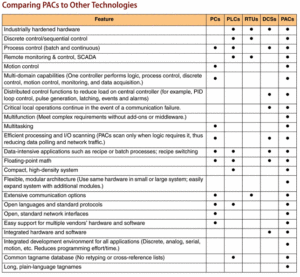
Industrial applications continue to increase in complexity, requiring controls that can integrate multiple systems that incorporate discrete, motion control, and process tasks and that can gather, process, and transmit real time data to company databases. Programmable automation controllers (PACs) can be one choice for managing this complexity because they combine the capabilities of several traditional control and monitoring systems. Typically, they have features found in programmable logic controllers (PLCs), distributed control systems (DCSs),remote terminal units (RTUs), and personal computers (PCs).
Even so, control manufacturers offer PACs with varying capabilities. Thus, there are several considerations to keep in mind with your selection. Read more

Got Control? Part 2

May 8, 2008 by  
Filed under Motion Control

So when is a PC (personal computer) a PAC (programmable automation controller) or a PLC (programmable logic controller)? They are all the same. They all have microprocessors. They are all programmable. They are all available with hardware that is rated for industrial environments, shock, vibration, temperature extremes and various other requirements. They are all connected to real world devices such as sensors, switches, etc. They all execute control based on a programmed binary model of a real world manufacturing process.

They have differing abilities in terms of data storage and throughput. In previous generations of PLC and CNC, the memory for those systems was very expensive and early memories were hand wound wire and discrete magnet memory. With the advent of mass manufactured memory for the PC, the industrial platforms have had to engineer hardware with different components to take advantage of competitive costs. A hard disk drive module was available for some PLC systems where extensive process information was needed.

In today’s market one vendor offers an industrial computer platform that replaces the PLC, the HMI (human to machine interface) and uses a touch screen interface, using the PC platform to reduce control system costs in many applications by doing several functions with the same hardware. Sounds like a Tablet PC engineered for the plant floor. Nothing unreasonable about that. Read more