Motors are Strategic Technology
November 1, 2009 by Steve Meyer
Filed under Commentary, Featured Mechatronic Articles, Manufacturing Trends, Motion Control
The 2007 Department of Commerce Census data is just now being released (how’s that for government efficiency?) and the good news is that the sector of the economy that manufactures electric motors and generators, a lot of which is used in industry for motion control applications, was up over 2002. The increase in total revenue was a whopping $12.37 Bil over $9.08 Bil 2007/2002. A couple of strange statistics show up in employment figures, total employees declined by 10,872 jobs, a full 20% based on the 2002 employment levels.

Electric generator
So we can register some gains prior to the slowdown in 2008, but there’s a catch. We have traded in 20% of our employment for about 30% growth in the market over the five year period. Those two facts cannot be resolved except by the fact that foreign suppliers have established operations in the US and are shipping products into the US for sale. And we continue to lose manufacturing based employment.
On a happier note, average salaries increased by about $6500 per employee, so the news is not all bad. And for those keeping score on health care costs, the industry paid an average of $4520. per employee for medical care.
But electric motors are used for all kinds of things. Putting your favorite beer into a bottle and onto a truck requires millions of dollars of mechatronic equipment to get the job done at the rate of 1-2 million bottles a day. You wouldn’t believe how much equipment goes into making frozen pizzas. Missile guidance and a lot of military applications like targeting required high performance motors. Disk drives are a huge user of brushless dc spindle motors.
And in order to make motors you have to have copper wire, steel laminations and magnets. Copper wire and lamination grade steel have become much more expensive in the last few years while Neodymium magnets have declined steadily in cost at the rate of about 7% per year. This has created a very strange situation where conventional AC motors with small high performance permanent magnets in the rotor have become more cost effective than their standard counterparts. This is a set of circumstances that no one in the industry expected. It was assumed that Neodymium magnets would always be expensive.

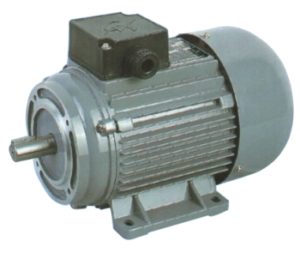
Electric Motor
And the really high strength “exotic” materials are. But there is this new middle ground where the costs have crossed over. And high volume appliance manufacturers are jumping on the new platform of price and performance.
In an unrelated event, General Motors, who has been having financial problems for a while, sold it’s Magnequench business unit off to a Chinese owner. Magnequench held some of the basic Patents for Neodymium magnets and was the largest and only producer of magnet grade Neodymium alloys in North America.
So where does that put us? There are no US companies that can make motor grade Neodymium magnets. Yes, the Magnequench factory is still in Indiana. And I doubt there going anywhere anytime soon. But still. Every disk drive motor, every brushless servo, every high performance appliance motor will be using more parts made by Chines and not American companies.
Certainly GM did what it needed to do, but the sale of a US company to a foreign entity normally requires review by Commerce. If you heard something about this, please let me know.
It’s time for some new ideas in the motor industry.
Electric Vehicles and Electric Motors
June 7, 2009 by Steve Meyer
Filed under Commentary, Design, Green Energy, Green Engineering, Industry, Materials, Mechanical, Motion Control
A friend of mine finally got delivery of a Tesla Roadster. This prompted discussion of the drive train and the fact that Tesla has had to go from two speed transmissions which were failing to a transmissionless drive train. The ultimate mechatronic challenge, the electric car, is also a challenger in terms of the precise application of electric motor technology.
But it has to be said that the motor and drive solution for the electric car is not where the problem has to be solved. Any motor can be made to run an electric car. What is critical is how you apply it. The starting conditions require high torque at low speed and the running conditions require low torque at high speed. So, typically, what looks like a small 5 to 15 horsepower running requirement at full speed, becomes a 150 horsepower starting requirement depending on how quickly you would like to start. If you want to keep up with a Corvette, it uses 450 HP to start.
And this produces a lot of confusion. Why not use at 2 speed transmission to help the situation. Fine, but the ones that are available can’t handle the dynamic response of the electric motor.
Can electronics help this situation? Interestingly, yes. There is a control algorithm generally called vector control which allows you to manage the rotor torque and stator torque separately. By varying the phase angle between the two, like advancing and retarding the timing of a mechanical distributor cap on an internal combustion engine, you get different speed torque curves out of the motor. COOL! Is there any downside to this?
Yes. You need more current to produce more torque. That doesn’t change. So you have to be able to supply the current, and you have to be able to manage the heat. The heat is transitory since you only need the high current during starting, but it is best to have sophisticated software running to keep track of the RMS temperature of the motor. Lower operating temperatures mean longer life and reduced risk of demagnetizing the motor.
So, yes, you can run an electric car with a garden variety AC motor, and with good electronics, you can make it run fairly efficiently. With higher efficiency motors, the benefit is increased driving range from a given power source. High efficiency motors are frequently smaller and lighter weigh, but a weight savings in the motor of 50 or even 100 pounds is not that big a factor in the driving range when the curb weight of the vehicle is 3000 pounds.
Basically, its F=ma. If you can reduce the mass of the vehicle, you reduce the battery payload required to power the car. Aluminum space frames, like on the Prowler, have been studied by the car industry and can reduce curb weight by 400 pounds and reduce cost by 10% at the same time. We need to bring all the mechatronic leverage to the situation that we can, if we are going to make electric cars that make sense. Before its too late for Detroit.
Super Size my Motor?
May 3, 2009 by Steve Meyer
Filed under Automation, Manufacturing Trends, Mechanical, Motion Control
There is an interesting problem with applying electric motors that is a constant source of difficulty, the nature of peak power versus continuous power. The problem is that few systems operate at a statistical average power demand. Frequently, this causes equipment designers to oversize the motor for the application. At the same time, however, this can put the motor in a very low efficiency operating range.
So what’s the right solution? Right sizing. Yes, just like Goldilocks and the Three Bears, not too big, not too small, but just right.
There are some great DOE publications on motor sixing that can be very helpful on the AC motor side, so make sure to give those a look. But the implications of how to deal with varying loads are complex, each requirement having its own unique conditions that need to be considered. Is an underpowered application actually safer? Sometimes, yes. I recently noticed that a particular orbital sander had been designed so that if the unit became momentarily overloaded, it stalled. Perfectly safe. In fact, this design is to be preferred because it prevents accidentally damaging a work piece by burying the sander in the wood and removing too much material. Who’d have thought of it? Certainly not Tool Time Tim. More Power!
In fact, most of us view more as better. More power means more production. Or does it. In an increasingly energy conscious community, more power means more cost. And that’s really what its all about. The value of the motor is not just in the purchase price, but also in the operating cost. Especially if the motor is expected to run for 8 years, 24/7. (That’s what the life expectancy of large AC motors is)
There’s another trick to the power requirement problem. How much time is spent at full load and how much time is spent at average power, or, what is the duty cycle? If the system is starting and stopping frequently it puts different constraints on the motor. If the system is typically starting only once an hour, then we can consider the thermal duty cycle of the motor. The momentary peak power requirement is insignificant and the vendor can usually tell from their modeling and testing of their products how much impact the peak current will have on the motor’s average temperature.
After all, its Thermodynamics 101 in the final analysis. Every energy transformation produces heat as a byproduct. How much heat a given system can tolerate is the key to its operating life. In electric motors, the key values are the insulation system’s temperature rating, usually in the range of 150 to 180 C and in the case of steppers, brushless dc and permanent magnet dc motors, the magnet’s ability to resist high temperature and high coercive magnetic fields that can be generated in the motor. Both sets of limits are generally well considered by suppliers when electrically controller motors are shipped as motor/drive combinations. This can get a little tricky when pairing motors from one vendor with controls from another vendor.
Top 10 Mechatronic Challenges
April 26, 2009 by Steve Meyer
Filed under Automation, Commentary, Green Engineering, Mechanical, Motion Control
I recently wrote on the mechatronic challenge of wind power. Converting wind into mechanical power that can be harnessed for man’s use has been going on since the 9th Century according to Persian historians. Certainly wind powered grinding of grains has been around in Europe for several centuries and, lest we forget, wind power pumping of water in the United States. So there is some irony to the cultural “buzz” about wind power at home and abroad, as if the technology were entirely new. There’s a lot of history, we’re just updating the technology to produce energy in the age of electricity.
Water has been used for power generation as well. Following a similar path, we learned during the early part of the industrial revolution how to locate manufacturing plants near waterways so we could convert water flow into mechanical power using the water wheel. This is, in fact the root of all modern motion control. All the belts and pulleys, cams, gear reduction systems follow from the work done in mechanical engineering from this period of time. All of the electronic analogs of the mechanical behaviors found in mechanical systems are the functions which we refer to in mechatronics today.
Wind power and water power gave way in the 1800’s to steam power as the improved steam engine of Watt became the standard of energy efficiency, or should I say “cost effectiveness”. Because the absolute value of technology is in its cost effectiveness.
Still, wind energy poses a huge technology challenge, as witnessed by the number of vairations that exist and new versions that are emerging. And hopefully improvements will continue to come from the creativity and imagination of engineers and inventors all over the world.
But what are the other big mechatronic challenges that come to mind?
Transportation certainly ranks in the top 10. We have seen hydraulic, pneumatic and electric vehicle solutions touted for a variety of uses, personal transport, delivery vehicles etc. Ballard Energy and General Motors have both been building hybrid and pure electric buses for city transportation systems for several years with some success. Interestingly, the electric bus is easier to engineer, which seems unreasonable, but the bus has more interior space to put things like batteries and a methanol converter for generating hydrogen for fuel cells.
But there is a great lesson in what appears to be an almost chaotic string of choices in the transportation arena. One solution will not work for all requirements. There are many people for whom a 40 mile per day drive cycle is perfect. The NEV, Neighborhhod Electric Vehicle, is a golf cart type solution that is rated for street usage, and because of its relatively simple performance requirements, is relatively easy to achieve and lowe cost. As we categorize cars with greater range, the problems get more difficult, and because of the storage limitations of batteries, have only been achievable as hybrids. But with some hybrid designs reaching 50 and 60 mpg (estimated), these vehicles may be great solutions for other users. Although, we must consider their cost effectiveness. If they cannot be introduced at prices well below $50,000 the absolute value of the technology is not very good.
So forget the 15 second soundbyte that will solve the world’s problems. It doesn’t presently exist.
I would like to hear from any readers about their picks for the Top Ten Mechatronic Challenge.
Linear Feedback Technology (Linear Motion Part 2)
April 19, 2009 by Steve Meyer
Filed under Automation
Linear motion is particularly impacted by the choice of feedback. And for most systems the use of feedback is not an option. Linear motors, for example, cannot be operated without a feedback device. And because of the linear motor’s roots in semiconductor manufacturing, the feedback is usually a high resolution linear tape scale.
How much feedback resolution is enough? Most of the time more resolution is better. But there is an element of control theory that says if the feedback resolution is ten times greater than the position accuracy that you are trying to measure, the control system can become unstable. The other side effect of extremely high resolution feedback is the tendency to “jitter” because it is responding to tiny variations in the real world, which the control system will then have to contend with. So spending extra money for high resolution feedback may cause other problems.
Where should the resolution be put? Obviously, if you are using a rotary servo motor, just use the feedback on the motor as the linear position reference. This works when the required resolution is not very high because in all mechanically linked systems, there is lost motion called backlash between the motor and load. But most motion controllers and many indexing drives contain dual feedback loops, so using an external feedback sensor will produce great benefit in accuracy and repeatability.
The big benefit in using linear feedback is the elimination of mechanical error as part of the control system. On a project I did a few years ago we were evaluating a special grinding machine that had a 13 foot long lead screw in it. The customer know the lead screw had wear and error in it, and that was part of the problem that needed to be addressed in rehabilitating the machine. Instead of replacing or re machining the lead screw, we specified an external linear tape scale feedback. The results were fantastic. Accuracy and repeatability were phenomenal and combined with an integrated servomotor system, led to a 300% increase inthroughput for the customer. Backlash? What Backlash?
How much distance do we need to sense? Some linear motors like piezo-electrics and voice coil motors have very limited stroke lengths. Similarly, different feedback technologies have scalability parameters such as sensing airgap and length requirements are considered. Some feedbacks work in the range of 2 to 6 inches in overall stroke length, some are capable of 3 feet, some up to hundreds of meters.
The exception is the stepping motor and leadscrew combination which can be operated without feedback on the assumption that the load is not varying dramatically. But even the leadscrew and stepping motor needs feedback when the load varies. Current detection can be used to determine if the motor has stalled, but doesn’t necessarily give you the opportunity to recover position without an external source. So the extra cost of external feedback is a judgement call based on the accuracy requirement and how “robust” the system needs to be.
The variety of types of linear feedback are equally challenging, and as with most things, must be considered based on cost and performance. The most popular feedbacks are linear tapescale systems that use reflected infrared beams that are interpolated to achieve very high accuracy. The classic linear feedback from the machine tool era is the glass scale which uses through beam optics and a grating embedded in glass to product the linear position information. Check out companies like Renishaw, Heidenhahn and others for details. Information on Heidenhahn’s latest innovation is featured on the Project Mechatronics website.
Over the last few years there have been a number of magnetic solutions where a magnetized linear scale is interpolated by taking the sinusoidal waveforms produced by Hall sensors or inductors, and digitizing the results. Integrated circuitry combining Hall effect arrays and functional support to linearize output are now the prevailing state of the art. Check out NewScale Technologies Tracker product for details on their new offering.
Linear Motion
April 15, 2009 by Steve Meyer
Filed under Automation
Electric motors are generally rotating machines. And over the roughly 100 years of electric motor history, incredible effort has been put into adapting the technology to do an almost infiinite array of tasks. Which is why it’s kind of ironic that in the industrial world, a significant number of applications require the conversion of rotary motion to linear motion. And, as with all things mechatronic, there are a variety of ways to solve the problem.
Most often, the first order of business is to couple the motor to a linear mechanism. The two most common are screw type actuators and belt drives. Both work well, both have relative strengths and weaknesses. Screws are very smooth and provide mechanical advantage like a gear reducer, but can add inertia mass and have acceleration limits. Belts are low mass and high speed but a stiff support system to permit proper tensioning.
Linear motion is generally about position, which is fundamentally a different behavior for electric motors. Most motors rotate at high speed, like an 1800 rpm ac motor. So positioning implies a whole range of properties that are not easily achieved. While we have achieved a wide variety of solutions for positioning, they are generally much more expensive and complex. Stepping motors are the only branch of electric motor technology where position is an inherent aspect of the motor’s operation. And this fact has made them very popular, especially when linear motion is required. A typical stepping motor solution is based on a 200 step per revolution motor and a 5:1 pitch lead screw. This makes the linear motion .001″ of travel per step. Simple, cost effective.
In many linear motion applications the top priority to is accuracy. And when the accuracy requirement is higher precision than .001″ or the speeds required are beyond what stepping motors can produce, then other options must be explored.
Linear motors are outstanding in overall performance. Acceleration, speed and accuracy are excellent and are the way to go where the costs are acceptable. They use high resolution (generally millionths of an inch) tape scale linear position feedback to achieve the precise positioning required by semiconductor applications. And this was the early field of use of linear motors. Once considered an “exotic” solution and very expensive and difficult to apply, the last few years have seen cost improvement and a wider range of applications for the technology.
An emerging technology for linear motion is the piezoelectric motor. Linear piezoelectric motors are available from a few suppliers and the simplicity and cost effective of this solution is making them an excellent choice for some linear motion requirements.
Most mechatronic solutions for linear motion depend on a feedback sensor to achieve position accuracy. This makes the linear position sensor a critical component in the design of linear motion systems which I will address in the next post. There are a number of options and some new technologies available to give designers more choices.
Time – Part 2
January 19, 2009 by Steve Meyer
Filed under Automation, Motion Control
Time is the single variable that ties all of motion control and mechatronics together. And if that is so, its impact on our design work cannot be underestimated.
The most basic feature of time is its relationship to work. The work done in a mechatronic system is defined through displacement over time. So a bunch of important variables get picked up. The force exerted in mechanical terms can be a torque for a rotating load or thrust for a linear load. The torque of a rotating load is the same as the current through the motor and drive. And this makes sense of why these performance characteristics are related.
The power rate of electricity usage is the Kilowatt Hour. The measure of work done over a period of time.
The horsepower is the mechanical unit of measure of work. One horsepower is the work done to move a 550 pound load 1 foot in one second. One horsepower is the equivalent of 746 Watts. Now we have a direct correspondence between the mechanical and electrical definitions.
If electric motors are rated in horsepower, the implied property is the amount of work that can be done using that motor to power a load. And an interesting anomoly occurs. In most situations the motor is built based on an arbitraty size, like 10HP, and not based on the load requirement, unless the application has sufficiently high volume to merit a custom design. A hard disk drive spindle motor is a case in which, because of the millions of units that will be sold, the motor design is unique. So its construction is specifically designed for the load it is applied to, the hard disk platter turning in a vacuum.
So in general application, electric motors are poorly matched to their loads because of the economics that drive motor manufacturing. The mis-match can be speed matching or power matching. This impacts energy efficiency more than the inherent efficiency of the motors themselves. Efficiency data is usually measured at rated power and can fall off dramatically for all load conditions less than maximum power.
The Power Rate of the system is directly related to the specification of the power semiconductors and mechanical contactors that are used to control motors. So when we think of torque being equal to amperes, the current rate dI/dt is the power rate throught the electronics side of motor control. In fact, the definition of the failure threshold in the power semiconductor, also called shoot through, is dI/dt.
Thinking about the relationship of torque and time, what happens when we consider acceleration? Acceleration is measured in units per second squared. Exponential. So when we start pushing system performance for a given load, as the allowable time for the motion decreases (cycle time decreases or throughput increases) then the torque requirement goes up exponentially, and the current requirement goes up exponentially as well. This requires a big increase in motor and drive size and cost, and in some cases reducing cycle times cannot be achieved.
Unless you change the inertia of the load. Aluminum is one third the mass of steel, and engineering plastics are often half the inertia of aluminum. So when you have the need for speed, don’t overlook material substitution as part of your strategy.
Time and Motion
January 11, 2009 by Steve Meyer
Filed under Automation, Motion Control
What is the one variable in the universe of motion control system variables that ties everything together?
Some time ago a friend of mine, Phd Mathematician, wrote a software program that optimized all the variables required to construct an electric motor. The obvious ones are simple physical variables like diameter and length of the motor housing. The issue of motor size can be arbitrary for most applications, but every now and then you get caught in a size constrained application like the well water pump that needs to have a 2″ outside diameter in order to fit inside a 3″ pipe.
Shaft diameter and length, or course, would have to be considered based on the amount of torque that must be transferred. And even though these are simple physical constraints, you caught in a more complex relationship because there is static torque and dynamic torque. In the dynamic consideration there are starting and stopping characteristics, each of which is often unique.
The time displacement curve is the cornerstone of all motion control. You can get pretty fancy with the analysis. You can refer to the first and second derivatives of the motion, acceleration and jerk, and define a lot of boundary performance issues that a target motor and amplifier must be able to provide or the application will not work.
An interesting side note on the time-displacement curve is that you can consider work done as the area under the curve. So integral calculus had some value in the situation.
And we haven’t really addressed the magnetic circuit yet. There are generally 2 magnetic elements in any motor. Usually one is an electromagnet and the other is a permanent magnet. So we need to consider all the associated variables of design in an electromagnet are copper windings on ferromagnetic metal cores. Wire diameter, number of turns, length of turn, length of end turn ( the un-used portion of the copper from a magnetic standpoint), the voltage, current and excitation frequency of the applied current assuming its coming from a PWM based solution.
And we’re just getting started. The magnetic performance of the core material at varying frequencies and temperatures. You get the picture. That nice, neat, simple little starter motor that’s attached to your car engine with two wires from the battery turns out to be pretty complex.
My friend the mathematician said that his program has 23 variables of design that were needed to define the electric motor. Pretty scary if you have to do tradeoff analysis to find the “perfect” design for a specific requirement. But it is way too much work to actually do all this analysis unless you are going to produce a whole lot of one design.
So is there any Unified Field Theory that brings all this stuff together? TIME! The one thing that unifies all motor considerations is time. And by looking at the system from this perspective it is sometimes possible to simplify things a bit, in an otherwise very complex system. We’ll look at this in further detail in the next installment.
Integrated Servo Motors
November 26, 2008 by admin
Filed under Motion Control
Santa Clara, California – Animatics Corporation, pioneer of Integrated Servo Technology has taken their best selling Integrated Servos, the SM2315D and SM2315DT and added power and functionality, while lowering the cost. The new products are called the SM2316D-PLS2 and the SM2316DT-PLS2.
Globalization and Emerging Economies Drives GMC Market Growth
October 22, 2008 by admin
Filed under Motion Control
Robust investments in manufacturing industries pushed General Motion Control (GMC) market growth worldwide in 2007. While economic expansion is expected to continue, future growth will be at a slower pace. The worldwide market for GMCs is expected to grow at a Compounded Annual Growth Rate (CAGR) of 6.7% over the next five years. The GMC market reached nearly $6.0 billion in 2007 and is forecasted to grow to over $8.2 billion in 2012, according to a new ARC Advisory Group study.