
Materials and Mechatronics
September 13, 2008 by Steve Meyer
Filed under Automation, Materials
A great scientist recently said that most of the new innovations in coming years would be in the materials science world. (Sorry I can’t remember the reference, or I would gladly give credit…) Seems like he may prove to be right.
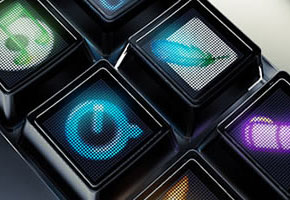
Organic LED materials and processes show the potential to replace the mainstream display technologies. Which is pretty impressive given the multi-billion dollar size of market for displays these days. Read more
On-Wafer Evaluation of MEMS Devices
June 6, 2008 by admin
Filed under Semicon, Test & Measurement
Testing at Earliest Stages in Development Can Help Lower Costs of Microelectromechnaical Systems.
By Mitsuhiro Nakamura
Agilent Technologies, Inc.
Recently, various devices using MEMS technology such as pressure sensors, accelerometers, and RF MEMS have been commercialized. Additionally, new devices such as silicon microphones, are rapidly evolving. The MEMS market started with the automotive industry and has been expanding to consumer products such as cellular phones.
This MEMS market expansion also applies pressure on manufacturers to lower their costs per device. However there are few opportunities for cost reduction. The limiting factors include:
• Low yields due to the precision process
• Slow throughput due to application of the physical stimulus.
A recent study (item 1 in the Appendix) estimates that 80% of the total production cost is attributed to the device packaging process and how defective chip inflow to the packaging process can contribute to cost increases. Therefore, we will discuss how to evaluate MEMS elements at the on-wafer stage in order to lower the total production cost.
The Continuing Evolution of Mechatronics

October 6, 2007 by admin
Filed under Commentary, Motion Control, Networks
It began as the integration of mechanisms with electronics. Since then, mechatronics has evolved, and for all practical purposes, includes nearly every engineering discipline.
By Andy Urda, Director Channel & Industry Marketing
Yaskawa Electric
In 1953, Yaskawa Electric began its active role in advancing technology in the field of motion control when the company introduced its servo motor line, the Minertia® Motor (named for minimum inertia). These servomotors made rotation exact to the proportion of conduction. Due to their very low inertia, they handle extremely fast starts and stops. Originally, they were applied to electrical actuators for the control of mechanical arms. Today, they are also found in many industrial automation applications. Yaskawa’s signature phrase of the late 1960’s and early 1970’s was “Mochintrol,” which was created from the combination of motor, machine, and control. Mochintrol became a registered trademark for the company in 1971. Read more


