Out Of The Gait: Robot Sets Untethered ‘Walking’ Record

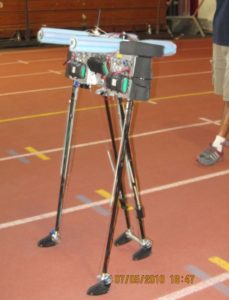
The loneliness of the long-distance robot: A Cornell University robot named Ranger walked 14.3 miles in about 11 hours, setting an unofficial world record at Cornell’s Barton Hall early on July 6. A human – armed with nothing more than a standard remote control for toys – steered the untethered robot. Ranger navigated 108.5 times around the indoor track in Cornell’s Barton Hall – about 212 meters per lap, and made about 70,000 steps before it had to stop and recharge its battery. The 14.3-mile record beats the former world record set by Boston Dynamics’ BigDog, which had claimed the record at 12.8 miles.

A group of engineering students, led by Andy Ruina, Cornell professor of theoretical and applied mechanics, announced the robotic record at the Dynamic Walking 2010 meeting on July 9, in Cambridge, Mass.  Ruina leads the Biorobotics and Locomotion Laboratory at Cornell. The National Science Foundation funds this research.

Previously, students in Ruina’s lab set a record for an untethered walking robot in April 2008, when Ranger strode about 5.6 miles around the Barton Hall. Boston Dynamics’ BigDog subsequently beat that record.

One goal for robotic research is to show off the machine’s energy efficiency. Unlike other walking robots that use motors to control every movement, the Ranger appears more relaxed and in a way emulates human walking, using gravity and momentum to help swing its legs forward.

Standing still, the robot looks a bit like a tall sawhorse and its gait suggests a human on crutches, alternately swinging forward two outside legs and then two inside ones. There are no knees, but its feet can flip up – and out of the way, while it swings its legs – so that the robot can finish its step.

Ruina says that this record not only advances robotics, but helps undergraduate students learn about the mechanics of walking. The information could be applied to rehabilitation, prosthetics for humans and improving athletic performance.

Cornell University
www.cornell.edu

The Future of Mechatronic Design

September 1, 2008 by Steve Meyer  
Filed under Automation, Commentary

I think mechatronics generally begins with mechanical design.  That’s just my perspective, it may differ in your experience.   If its a power window in a car, a hard disk drive platter machine, a blender, an amusement park ride or display, a surgical robot, whatever.  They all start with mechanical design, performance goals and boundary conditions that are required for the mechanical system to be useful.

This is why there needs to be great emphasis on the design of software tools that are extensions to the 2D and 3D CAD products that are currently available.  Obviously, if you are engaged in mechanical design, you are in a unique position to the final outcome of the design project.   The mechanical design work sets the boundary conditions of what is possible. Read more

Ensure Gear Reducers Contribute to System Efficiency
April 3, 2008 by admin  
Filed under Mechanical

More than $30 billion is spent on electricity dedicated to electric driven systems, of which, nearly 70% goes to motor systems. There are ways to reduce this cost in your motion based mechatronics system.
By Alex Howe, Application Engineer
US WITTENSTEIN Group

Motor-driven equipment in manufacturing currently accounts for more than 2.3 quads, or 2.3 quadrillion BTUs (roughly 674 billion kilowatt hours) of energy use, which equals nearly 23% of all electricity sold in the United States. Read more