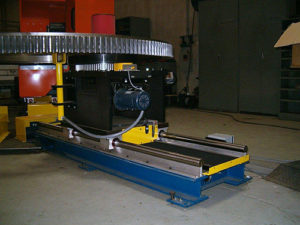
Linear Motion

April 15, 2009 by Steve Meyer  
Filed under Automation

Electric motors are generally rotating machines.  And over the roughly 100 years of electric motor history, incredible effort has been put into adapting the technology to do an almost infiinite array of tasks.  Which is why it’s kind of ironic that in the industrial world, a significant number of applications require the conversion of rotary motion to linear motion.  And, as with all things mechatronic, there are a variety of ways to solve the problem.

Most often, the first order of business is to couple the motor to a linear mechanism.  The two most common are screw type actuators and belt drives.  Both work well, both have relative strengths and weaknesses.  Screws are very smooth and provide mechanical advantage like a gear reducer, but can add inertia mass and have acceleration limits.  Belts are low mass and high speed but a stiff support system to permit proper tensioning.

Linear motion is generally about position, which is fundamentally a different behavior for electric motors. Most motors rotate at high speed, like an 1800 rpm ac motor.  So positioning implies a whole range of properties that are not easily achieved.  While we have achieved a wide variety of solutions for positioning, they are generally much more expensive and complex.  Stepping motors are the  only branch of electric motor technology where position is an inherent aspect of the motor’s operation.  And this fact has made them very popular, especially when linear motion is required.  A typical stepping motor solution is based on a 200 step per revolution motor and a 5:1 pitch lead screw.  This makes the linear motion .001″ of travel per step.  Simple, cost effective.

In many linear motion applications the top priority to is accuracy.  And when the accuracy requirement is higher precision than .001″ or the speeds required are beyond what stepping motors can produce, then other options must be explored.

Linear motors are outstanding in overall performance.  Acceleration, speed and accuracy are excellent and are the way to go where the costs are acceptable.  They use high resolution (generally millionths of an inch) tape scale linear position feedback to achieve the precise positioning required by semiconductor applications.  And this was the early field of use of linear motors.  Once considered an “exotic” solution and very expensive and difficult to apply, the last few years have seen cost improvement and a wider range of applications for the technology.

An emerging technology for linear motion is the piezoelectric motor.  Linear piezoelectric motors are available from a few suppliers and the simplicity and cost effective of this solution is making them an excellent choice for some linear motion requirements.

Most mechatronic solutions for linear motion depend on a feedback sensor to achieve position accuracy.  This makes the linear position sensor a critical component in the design of linear motion systems which I will address in the next post.  There are a number of options and some new technologies available to give designers more choices.

Link Shaft for Belt Drive Linear Modules

February 20, 2009 by admin  
Filed under Mechanical, Motion Control

rw-ez2.jpg

Belt driven linear actuators continue to increase in popularity as designers look to mechatronic systems to move products more quickly, cleanly and efficiently. Larger and faster gantries are being built for an increasing variety of applications in diverse new fields. Pick and place devices, inspection systems, and general material handling continue to take advantage of the speeds and lengths of travel these components offer.
Read more

DualVee® Washdown Wheels

January 13, 2009 by admin  
Filed under Motion Control

Pittsburg, CA – - Bishop-Wisecarver Corporation announces its new patent pending washdown wheels, the latest addition to the company’s signature DualVee product line. Designed primarily to meet the extreme demands of food processing equipment linear motion applications, the washdown wheel significantly extends bearing life, and is interchangeable with standard vee wheels for ease of replacement.

bwc dualvee washdown.jpg

Available in sizes 2 and 3, DualVee washdown wheels feature an all stainless steel construction, FDA approved grease, an outer shield, and inner seal for added protection from liquids and debris. The rubberized metallic shield acts as a momentary seal when subjected to a stream of high velocity washdown fluid. The fluid velocity causes the rubberized shield to deflect and conform to the metallic surface of the wheel, sealing against ingress of liquids. The inner seal provides the principal line of defense, ensuring that external fluids are kept out of the wheel while retaining the internal lubrication grease; both important factors affecting the life of the wheel. Once the stream is directed away from the wheel, the deflected shield returns to its original position, allowing any residual fluid that entered the zone between the shield and seal to drain out or be spun out by centrifugal force.

For more information on DualVee washdown wheels visit www.bwc.com/products/dual-vee.html.

www.bwc.com

Animatics’ Harmonic Linear Drive Series
November 26, 2008 by admin  
Filed under Motion Control

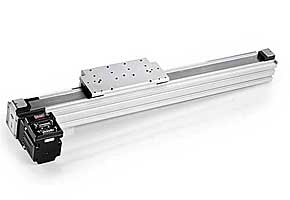
Santa Clara, California – Animatics Corporation, through OEM Dynamics Linear Division, has expanded its product line into the Linear Actuator market with the release of the Harmonic Linear Drive Series.

Read more