Mechatronics and Economic Recovery

Mechatronics is a major driver in economic recovery.  That may sound like an extreme claim, but it is something I experience with some regularity.  Every time someone comes up with a better solution for a process or new way to make a piece of machinery, there is economic recovery.

Mechatronics doesn’t get the attention of the President of the United States.  Maybe it should.  But the American economy is affected every time someone develops a new process or machine.  It just doesn’t make the headlines every time.

When companies compete for and wind marketsthare based on sales of machinery that others use in manufacturing.  The company that produces increased throughput or new features and benefits adds values to its customers’ operations.   And to the extent that machinery suppliers can capture that value for their customer, they their market, revenue and employment.

Mechatronics is what drives low prices for your favorite can of beer or soda that costs only pennies.  From the high impact can maker that runs a snappy 240 cans a minute, to the pallitizing machines that load 80 cases of your favorite beverage in less than two minutes ready to ship out on a truck.  All that productivity comes from mechatronics.

As the discipline of mechatronic engineering matures, the cost of that technology continues to decline creating new opportunities to drive new improvement with that technology in many different industries.  Better motion control technology means higher speed, higher accuracy, reduced waste, ongoing reduction in complexity and decreased commissioning cost.  All of which leads to new products, markets and economies.

Recently several suppliers like National Instrument and Rockwell have developed the interface between the design phase of mechatronics and the deployment of hardware.  This new frontier is the simulation realm where engineers can simulate and iterate their design ideas in software extensions of the solid model environment.  This development, while relatively recent, integrates the mechanical design environment with the applied aspects of mechatronics.  And in doing so, simulation gives engineers the tools to quickly perform complete design iterations in a few hours, without the need for expensive hardware iterations, lowering the cost of design and increasing the performance of the results.

More and better motion control means new opportunities to grow the economy.  Growing the economy is what we do best.  So keep those great mechatronic products coming.  They are more important than ever.

American Entrepreneurship 101

In my travels, I continue to find people hard at work doing something that has never been done before.  With the hope of making a profit while doing it.  Just such a situation came up recently when I met with the owner and founder of Transcon Steel.

Among the mainstays of an industrial economy is construction, housing and commercial in particular.  While these industries are incredibly competitive, there is always room for innovation.  Precisely because it is a mature, competitive industry, really ground breaking solutions are sometime hard to find.

Transcon Steel is a small startup company in Georgetown Texas that makes structural steel building systems.  The innovation comes from the fact that Transcon roll forms flat sheet metal into structural shapes that are highly optimized to reduce weight and increase strength.  The steel structural shapes are formed into large panels with compressed foam which results in structures that are super light weight and extremely high strength.

The new structural panels permit construction of buildings in a variety of applications.  So called “temporary housing” for oilfield crews in remote area can be built in hours instead of days.  Heating and cooling costs are a fraction of conventional structures.  All of which leads to increased opportunities to serve unique construction applications with better solutions.

Transcon’s big challenge will be to create the manufacturing resources needed to produce the structural panels in very large numbers.  The enabling technology of the manufacturing processes?  Mechatronics. The roll forming of sheet metal is a classic application requiring high performance drives to de-reel the strip steel rolls and servo actuators to follow the roll throughout the various forming process that take place to make the final product.

The compressed foam requires unique tooling to form large rectangular panels that can be filled with foam, compressed with hydraulic actuators and cured with heat and pressure to form the final super dense structures.  Amazingly, the cores are made from material that is similar to the conventional styrofoam cups we use for coffee, yet, when the basic material is processed correctly, it becomes strong enough to withstand blows from a sledgehammer.  When it is bonded to an already strong steel frame, you have a complete building system that has incredible structural strength and insulation value.

Transon is negotiating enough new business that it will need a new facility 4 times the size of it’s present location and will hire CAD designers and plant personnel to support it’s manufacturing needs.  If they are successful at marketing the technology in other countries, it will be more of the same.  Lots of it.

And that is how job creation is done.  Someone with an idea, willing to work hard, taking risks, finding people to come alongside and help, to deliver a solution.  Making lives better by employing people, and by delivering a product that provides shelter at a lower cost than the traditional products in the building market.

American Entrepreneurship.

Doing More In the US

The old business school motto, doing more with less, can have some interesting applications.    American manufacturing is going through a renaissance of sorts.  Across many industries there are substantial efforts to bring more manufacturing back to the US.

A lot of it is precisely ‘doing more with less’.  How do we make the same quality of parts at prices low enough to compete with foreign competition?  It’s not easy when the typical pay scale for manufacturing labor is $8 a day in some parts of the world.

There are a couple of obvious components to price competition that don’t get a lot of attention.  Scrap rates and delivered cost.  When a US company buys parts from offshore, any defective parts are very costly.  The direct shipping cost, duties and processing fees are additional and can be 10-15%.

During my years at Rockwell Automation, we investigated the cost of selling US products in different parts of the world.  Depending on where in the world we are talking about, the shipping and logistics can accumulate between 25 and 40% additional cost to the product being sold.

So the cost of scraps and logistics are the minimum cost hurdles for companies seeking to export their products to the US.  Low cost producers have to make parts cheaply enough that the landed cost and scrap rates cost out less than the price of producing them in the US.

Doing more manufacturing in the US requires finding creative ways to lower costs.  That is the second area that is undergoing change.  American manufacturing technology is finding ways to reduce machinery and process costs.  And this area of effort may provide key strategies that will help the US gain back ground in the pursuit of more world class manufacturing.

Innovation processes like additive manufacturing allow fabrication of metal parts with no machining.  For higher levels of precision there are new machine tools that can do final machining to less than 0.001″ accuracy and the costs of machine tools are lower than ever.  These are the keys to producing high quality parts at lower costs.

There are unique mechatronic solutions that can improve machinery performance across a wide range of applications.  The Acme screw which is very inexpensive, has limited accuracy but plenty of torque handling capability.  What happens if you can add a very inexpensive linear feedback technology to the simple low cost Acme screw?  You get a really high resolution linear motion system that is very inexpensive.

The great news is that these products are currently available.  And that means that making better machines that make better parts at lower cost is practical, achievable and there are no technical challenges.  Common off the shelf parts will get it done.

Servo or Drive?

January 21, 2012 by  
Filed under Automation, Industry, Motion Control

When does a rotating load require a drive or a servo?  I run into this issue on a weekly basis.  Everyone has their own answer.   As much as this may be a matter of opinion for most people, there are some guidelines that can help make this question more straightforward.

Some people define servo’s as closed loop versus drives which are open loop.  The term servo does require that there is a feedback device to provide the loop closure.  But there are many AC drive vendors making closed loop inverters to enhance the performance of the motor.  AC drives with feedback are generally used where positioning is required.  So the feedback element is not the determining factor for defining if an application is AC or DC.

The overall power level may define one versus the other, but not always.  Brushless servo motors are generally limited to 7″ or 8″ diameter and an equivalent horsepower rating of 20-30 horsepower.  There are frameless motors with even higher horsepower ratings.  But  the size and power rating are strictly a function of manufacturing and marketing constraints.  For a major manufacturer, the question is really, how many motors of a given size are we going to sell?  Based on the high cost of Neodymium permanent magnets, a larger servomotor is going to be very expensive.

But overall power ratings are not limited when you consider products from specialty companies like Powertec.  Powertec takes standard AC motor frame designs and increases the power density by adding embedded permanent magnets on the rotor.  Since the magnets are Ferrite, which aren’t as expensive, they are much more economical and allow designs as big as 400HP.  So power level by itself doesn’t determine what technology to use.

The real answer is in the load conditions.  What is the dynamic response required for the target application?  The rate of change of the load is the key.  Most AC drives are specified in terms of the frequency response or dynamic response of the power electronics.  This important parameter is expressed in Hertz.

Dynamic response is the ability of the drive to regulate speed when the load varies.  The load torque can change significantly, usually 90-100%, and the drive will recover the set speed within the time defined by the dynamic response.  Typically, an open loop AC drive has a 10 hertz dynamic response, which means that it will regulate to 1/10th of a second.

AC drive technology has improved to the point where dynamic response can reach 200 Hertz when a rotary encoder is added to the motor.  This means the drive can regulate load variations wiithin 5 milliseconds.  Which is pretty fast when the load mass is high enough to require a motor of 25 horsepower or larger.

The basic physics are simply that the bigger the load, the slower the dynamic response.  You just can’t make a ton of rotating mass change speed really quickly.  And that’s how the controls should respond.

The Next Industrial Revolution

Modern manufacturing is largely the result of Henry Ford’s innovation, assembly line mass production.  The goal of which was primarily to make cars available to large numbers of people due to significantly lowered costs.   No other single innovation has contributed as much to increase the quality of living conditions throughout the world.  Mass production has made more goods available to more people in more places than any other system in the history of mankind.

The electric light, for example, which was coveted 100 years ago as the great solution to night time darkness, making obsolete the candle or gas lamp.  Mass production has made the light bulb an inexpensive  commodity on the verge of extinction at about 25 cents per bulb.  The desire to reduce energy consumption is ushering in the age of the light emitting diode (LED) as the replacement technology for electric light.  Every effort is under way to reduce LED costs by any means possible so that illumination will be available that is even cheaper than incandescent lighting when the energy cost over ten years is factored into the new technology.

Even generating and delivering electricity is the result of applying the principles of mass production.  Large generating facilities are able to generate power cost effectively through economy of scale, selling the power profitably at 4.5 cents per kilowatt hour.  Wire, cable, switching systems and other infrastructure are generally costed in at an additional 2 cents per kilowatt hour to deliver the power to your door.  This is an incredible deal, trillion of dollars of resources at your disposal for pennies.

But mass production is not the answer for every aspect of modern society.  Lowering the cost of mass-produced goods implies that there is a requirement for the sufficient numbers of a product to warrant the investment in the necessary processes and tooling to accomplish the task.

Enter 3D printing technology.  Also known as “Maker bots”, this new class of tools is making fabrication a  new American pastime at incredibly low cost.  Where 3D printing equipment has recently been the domain of well-funded large corporations , selling at $10,000 to $20,000 each, 3D printer kits are available at less than $1000.  And lest you think that these are only toys for boys, the additive manufacturing paradigm has taken hold in the metals industry producing high quality parts in various steel alloys and even in titanium.

Why does it matter?  Because anything that lowers the barrier to market entry for new products creates the opportunity for people to enter a market that was previously inaccessible.  The hidden relationship is financial, it is the cost of amortizing the manufacturing resources across a given number of products that makes startup of a new product impractical.  So barriers to entry in new product development are primarily the result of amortization costs.

What happens when a new technology introduces a significant reduction in the amortization cost?  You get the opportunity to experiment with things because the cost of iterating the design is low.  New products can be test marketed and improvements made because there is no major investment in tooling that would have to be modified in order to change the design.  You don’t have to get it right the first time.

And that means that anything is possible.

Next Generation Manufacturing

As a follow on to the last post, I have been investigating the cost of manufacturing equipment.  The classic machine tool is the most widely used piece of equipment for fabricating just about anything made out of metal.  The machine tool has been quietly undergoing it’s own revolution since it’s inception in the 1950′s.

The traditional metal cutting machine tool has been around since the 1800′s and was entirely manually operated.  Since the machines were manually operated, the dexterity of the operator became a major factor in accuracy and repeatability of part manufacturing.  Because of the skill required, we still have the term “master machinist” in circulation, even though most machining today is automated.

During the Second World War, the Air Force was confronting the difficulty of manufacturing airplane parts.  Through the work of John Parsons and MIT, the first “punch card” controlled machine tool was built.  Parsons’ company was using early punch card computers to generate a larger number of points along the curve of a wing brace.  The numerical information was then used directly by machinists as a look up table for manually positioning a milling tool.  Parsons realized that if they could motorized the manual process, it could greatly increase the speed of the machining process, lowering costs dramatically and increasing accuracy at the same time.

Gordon Brown’s Servomechanisms group at MIT has recently been working on early forms of closed loop dc motor control for the gun turret on B-29 bombers.  By combining these recent technologies to numerical punch card calculation approach the first Computer Numerical Controlled Machine Tool was demonstrated.

The rest, as they say, is history.  The lessons learned in computer numerical control have been instrumental in every major field of manufacturing.  Cars, electronics, robotics, would not be feasible or cost effective without the underlying control technology of CNC.

Which brings me to a 2 major points as we contemplate the next generation of manufacturing.

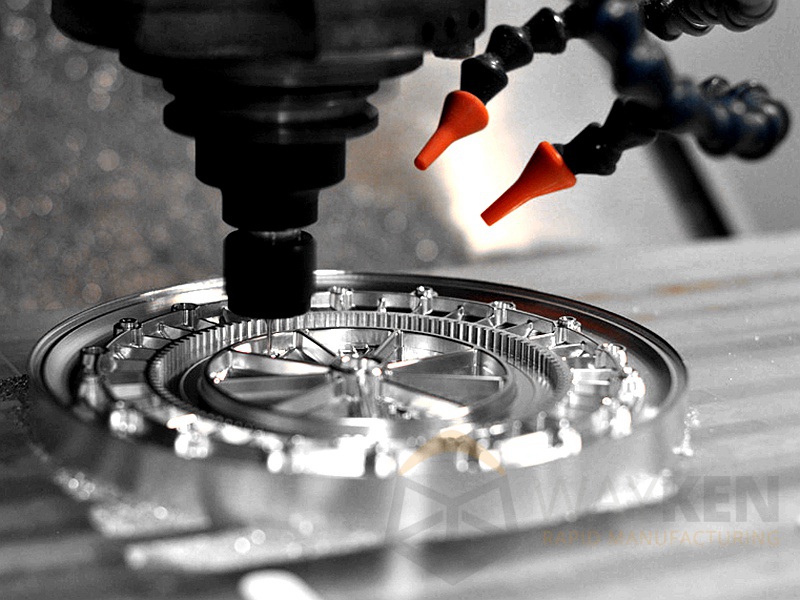
Additive manufacturing is maturing rapidly with a wide range of materials, steels and titanium are now available, and precision is improving at the same time.   The surface finish requirements for a large number of parts cannot be achieved with a strictly additive process.  The new wave of additive manufacturing requires a complementary subtractive technology at complementary prices.

Secondly, while there are an increasing number of machine tools at low cost, they are not CNC.  This will likely be the next “breakout” technology.  There are a number of technical hurdles that have to be addressed in terms of reducing the cost to a level comparable with the Makerbot.  With the current generation of dedicated motion controller chips, lower cost step motors and low cost feedback technology, this should be a slam dunk.

Get your pencils out and get after it!  There’s some serious money to be made here.

2012, Year of Opportunity

2011 was a difficult year for many sectors of the US economy.  World markets were about the same as at home.  The general weakness was felt world wide with currencies, especially the dollar and the Euro, declining due to bank failures in EU, financial crises in Greece and Italy, unrest in the Middle east creating concerns about stable supply of oil, runaway spending in the US and low sales numbers in new car sales and new home sales, two of the “bellweather” indicators of economic strength.

Alternative energy in the US has failed to produce the return on investment or to create new jobs in any significant numbers.  Car sales have picked up significantly over 2011, but not nearly at the rate of 16 million cars/year as in the heyday of that industry.  The real estate bubble has burst after a decade of speculation and bad lending practices that continue to depress new construction.

The second industrial revolution, Henry Ford’s industrial revolution, was about mass production and cost reduction.  For almost 100 years we have been perfecting the centralized manufacture of almost everything around us.  Economies of scale that enable volume manufacturing of consumer electronics at lower cost year after year are the result of the Ford approach to manufacturing.

So where do we go from here?  We start re-inventing the industrial revolution.

The new wave of manufacturing has begun with the advent of the Maker Bot and a family of low-cost fabrication tools that can manufacture based on 3D printing techniques.  While solid model prototyping has been around for some time, the magic ingredient is a new family of machines that cost less than $2000. and some recent new entries around the $1000 mark.  At these price points, it doesn’t take a lot of volume to justify the purchase of one of these machines.

There are advanced processes that are becoming available to generate sintered metal parts, even titanium parts, using processes resembling the additive manufacturing process.

Amortization cost is the secret.  Lowering amortization costs and minimum order quantity at the same time results in a fantastic breakthrough in productivity.  It also lowers the barrier to entry into new markets.  So if you have an idea for something that’s never been done before, the cost for development may be a lot lower than you think.  And thousands of people have begun to jump into the mainstream economy because of the availability of these new tools.

While the “maker” tools are limited to plastics, there is progress in the metals arena as well.  The computer numerically controlled (CNC) machine tools have traditionally been the domain of 6 figure costs, HAAS has been making $50,000 machines and last year Tormach entered the market with the “Personal CNC”, a high quality machine that is priced at $10,000.

My prediction?  There is going to be a lot of activity at the $10,000 and below price point to come up with low cost machine tools as a complement to the “maker” bot 3D printer technology.  Additive manufacturing will require a complementary subtractive manufacturing infrastructure at a comparable price point.

And creative American engineers and tinkerers will be leading the way.

Innovation in Motors for Mechatronics

Innovation is the watchword of mechatronics.  The pressure for solutions in alternative energy continue to push the boundaries of design in electromechanical systems.

In the wind energy arena the biggest change has been the shift to direct drive permanent magnet generators.  By eliminating the gear “increaser” to convert the low RPM of the propeller system to a high RPM for a standard high power generator.  This is crucial step in bringing the cost of wind power down. Current systems are weighing in at 100 tons and have to be suspended above water or land 165 feet in order to pick up sufficient wind currents to be economically practical.

There is no single solution that is ideal for wind applications.  One supplier has a generator that is made up of 4 smaller units on a single large ring gear.  This system seems to have significant advantages in reducing the size and weight of the generator and makes maintenance more simple in the event of a failure.

Among the major mechatronic challenges driving change in the motor industry, electric vehicle applications are continually pushing the boundary for energy density and efficiency.  The performance demands of electric vehicles and other mobility applications make every percentage point of efficiency crucial to the range of the target vehicle.  This has led to a rash of new motor and drivetrain designs with a variety performance capabilities.

Each new innovation seeks to organize the basic materials of the electric motor in a new way to improve some aspect of performance.  Electric motors are copper conductors, “soft” magnetic steels and many times, permanent magnets.  The basic costs for copper wire at $5-6 a pound, commodity strip steel is about $.50 per pound but has to be punched in precise shapes, coated with insulation and stacked into larger assemblies, and $16. per pound for permanent magnets.  Complex processes associated with motor manufacturing make motor costs considerable.

In a recent development teams in academia in Australia and the US have developed simple low RPM motor structures based on polymer actuators referred to as “artificial muscle”.  While this development is in its early phases, the simplicity and low cost are significant and very appealing.  A demonstration of the new technology can be seen on YouTube at;  www.youtube.com/watch?v=ZcCPNJR5PCMand it is very much worth the watch.

The only sure thing is that we continue to meet the challenge of new market needs with innovation.


Tranportation, Economics and the New Solutions

In the US, and most industrialized economies, the second largest expense of individuals and households is personal transportation.  Given the hundreds of man-years in development of the technology, the extremely low cost and high energy density of gasoline and diesel as fuels, it is not surprising that the dominant means of transportation is combustion powered.  Cars, buses, motorcycles, even bicycles are powered using the same basic combustion approach.

Considering the possibilities of improved personal transportation, the consequences of a major change in transportation technology are significant and should be carefully considered as we move forward.

The major impact of all the technology being promoted these days is increased efficiency and reduced fuel consumption.  Whether your motivation is reducing emissions and cleaning the air, or you are interested in reducing your cost of transportation, the requirement is the same; get more miles out of a gallon of gasoline or eliminate gasoline usage altogether, as is the case for a pure electric vehicle.

Across the entire population of cars in the US, the average fuel efficiency is around 20 miles per gallon. Despite the demand for higher fuel mileage from consumers, this situation hasn’t improved much in the last few decades.  A dismal thought in contrast to the claims being made these days for the new solutions.

The US consumes 383.25 million gallons of gasoline and diesel fuel per day.  This all goes into transportation.  The only fuel going into electrical generation is in diesel gen-sets for backup and remote power, just in case anyone is thinking about the barrel- of-oil-to-electricity energy equivalency.

Imagining a future in which gasoline usage declines is not difficult.  I drive a Ford Fusion for work which is averaging 30 mpg combined city and highway.    If the US fleet average is 20 mpg, increasing that average to 30 mpg implies decreasing the amount of gasoline sold by 1/3.  Currently, gasoline retails for $3.25/gallon, or $453 Billion annually at the pump.

So a sharp change in usage due to efficiency or an increase in the number of electric vehicles, is cause for concern from oil & gas exploration companies, gasoline refiners, distributors and dealers.  Unless gasoline prices continue to go up.  In which case there would be less gasoline solid at roughly the same total revenue, which suggests that higher profits might be the side effect if the true cost doesn’t go up.

What about tax revenues?  The direct state and federal tax on gasoline is about 40 cents per gallon.  This does not include large excise taxes collected by the states, taxes paid by refiners and distributors, etc.  In fact, it would be hard to calculate how much of gasoline pricing is taxes and how much is the cost of the product.  Regardless, at 40 cents/gallon, the daily revenues are $153 million and the annual is above $55.8 billion.

Given the current economic picture, is there any level of government that is willing to give up the tax revenue from gasoline?  Probably not.  Is this any different than “Dollars for Oil” at the UN a couple of years ago?  Probably not.  But we thought that was a scandal.


Unique Solutions in Material Handling

Moving products around is mechanical work.  When the work is done by a control system and actuators its mechatronics.  Mechanical work, whether by humans, by horses, by hydraulics, electrics or whatever, is still work.  Figuring out what technology approach will be the most cost effective way to get the work done is the challenge.

Many of the constraints of the work are environmental.  If work is being done outdoors, then temperature and humidity are a factor.  Felling trees and in the forest requires extremely high forces due to the work needed to cut through a tree and drag it to a truck to be hauled off for processing.  Processing trees, even in a plant environment, requires some serious hardware, 125 horsepower band saws are not unusual.

Doing work on a ship or oil rig has additional constraints because of the presence of explosive fumes and fuels.  Often the need to avoid any possibility of igniting a combustible atmosphere causes engineers to apply pneumatic control systems.  Yes, there is still a compressor somewhere to generate the compressed air supply, but that is usually remote or contained to avoid exposure to the volatile atmosphere.

Environmental constraints come in many forms.  Extremely high temperatures push the limits of what is possible.  Making glass, semiconductors, and primary metal processing are all high temperature environments where engineers have developed whole technologies in order to bring us the materials we use in everyday life.

The simplest action of rolling or sliding becomes a real challenge when environmental constraints are added to the work statement.  Sawdust becomes a potential abrasive in woodworking environments that can introduce severe wear in moving parts.  Corrosive and explosion proof atmospheres as well as food industry applications introduce all sorts of chemical compatibility problems that require special materials and processes in order to meet strict guidelines for safety.

As always, resourceful engineers have worked out solutions for all of these difficult applications.  One family of solutions to rolling applications is the use of all ceramic bearings.  No steel, no lubrication.  None is needed because the ceramics are extremely high purity to start with and have extremely high precision surfaces eliminating the need for lubrication.  No outgassing or contamination to worry about.

Other solutions take the form of air bearings and non-contact material handling devices.  Air bearings have become more readily available for conventional applications, but are particularly compelling in large machinery applications where precision is required.  Large flat screen display glass  presents unique challenges that successfully addressed using a combination of air bearing regions and vacuum regions to move the glass without actual contact and with overall flatness measured in millionths of an inch.

A unique solution in pneumatic material handling takes compressed air driven into a funnel shaped recess and creates a vacuum in the center and an air cushion at the edges where the air is exiting.  This creates a vacuum pickup that never quite comes in contact with the part, leaving no marks.  Perfect for solar cell and some food and beverage applications.

Engineers continue to meet the unique challenges of industry and create commerce at the same time.  And that’s what it should be about.

« Previous PageNext Page »